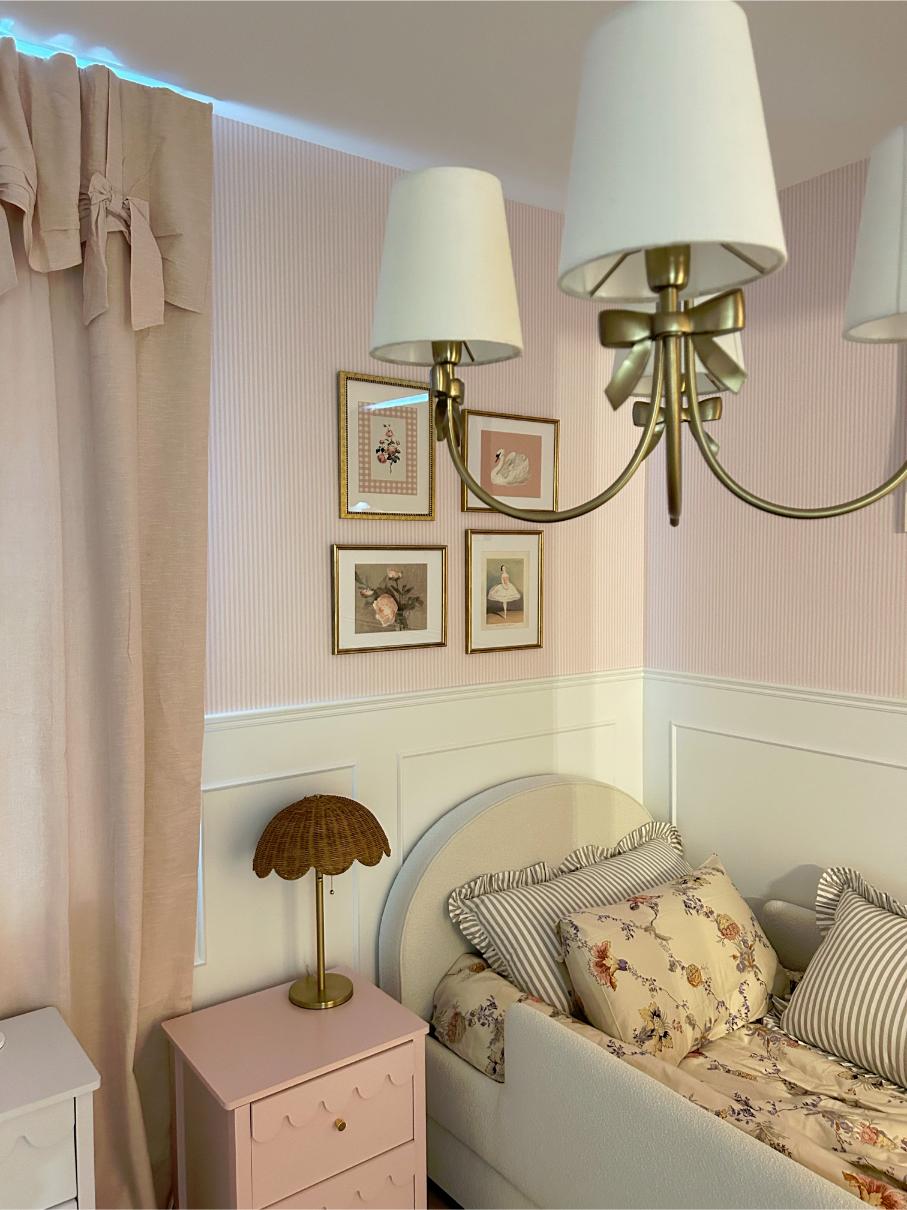
Can a children’s playroom be both fun and fantastically luxurious ?
Designing a children’s playroom is an opportunity to create a space filled with imagination, joy, and discovery. For parents, it is also a chance to reflect their lifestyle and aesthetic standards, even in areas dedicated to their children.
While playrooms are traditionally associated with bright colors and casual furnishings, today’s luxury interiors invite a more thoughtful question: can a children’s playroom be both playful and refined, expressive yet elegant?
The answer lies in balance. A well-designed playroom can support creativity and freedom while remaining visually cohesive with the rest of a sophisticated home. By approaching the space with the same design rigor as any other interior, it becomes possible to create a playroom that feels joyful for children and reassuringly elegant for adults.
Understanding the Foundations of a Well-Designed Playroom
Before introducing any notion of luxury, it is essential to understand what makes a playroom truly successful. At its core, a children’s playroom must be a safe, comfortable environment that encourages exploration, creativity, and movement. Functionality and emotional comfort are the foundation upon which everything else is built.
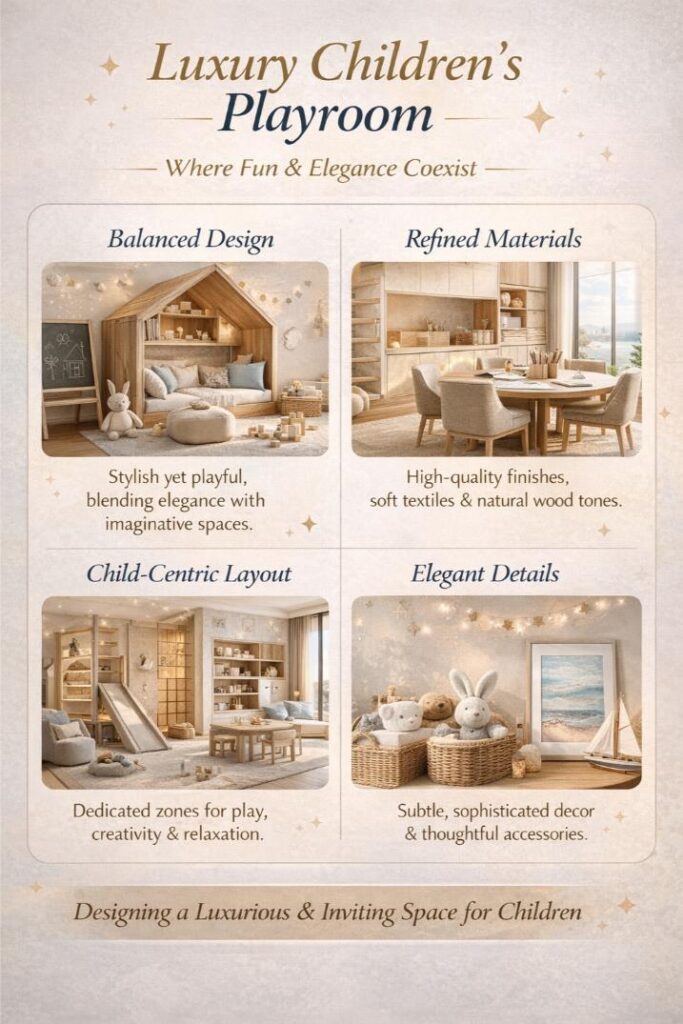
The layout plays a critical role. Whether the playroom occupies a dedicated room or is integrated into a larger living space, it should allow children to move freely without obstacles.
Open circulation areas promote active play, while clearly defined corners help children intuitively understand how to use the space. Soft rugs or tactile flooring materials can provide both comfort and acoustic insulation, making the room pleasant for children and adults alike.
Equally important is the selection of activities and objects within the space. Rather than overwhelming the room with toys, a curated approach is far more effective. Educational games, building elements, creative tools, and a limited number of imaginative play objects encourage deeper engagement and prevent visual clutter. A refined playroom is not about abundance, but about intention.
Finally, incorporating quieter zones is essential. A reading corner with soft cushions, warm lighting, and carefully chosen books introduces calm and balance. This contrast between active and restful areas reflects a thoughtful understanding of children’s rhythms and contributes to a more harmonious environment.
Where Playfulness Meets Refined Luxury
Luxury in a children’s playroom does not mean excess or extravagance. Instead, it is expressed through quality, coherence, and timeless design choices. A luxurious playroom should feel like a natural extension of the home, rather than a disconnected or overly themed space.
Furniture is a key starting point. Choosing well-crafted pieces with clean lines ensures durability while maintaining elegance. Upholstered seating for parents, integrated benches, or custom-designed storage units can elevate the space without compromising its function. Materials such as high-quality textiles, soft leathers, or refined wood finishes add depth and warmth, allowing the room to age gracefully as children grow.
Color palettes deserve particular attention. Rather than relying solely on bright primary colors, a more nuanced approach introduces soft neutrals, warm tones, and subtle accents. Muted blues, gentle greens, warm beiges, or soft pastels can coexist with playful details, creating a calming backdrop that supports imagination rather than overpowering it.
Themes, if used, should be approached with restraint. Instead of literal or overly decorative motifs, abstract references to nature, travel, or storytelling can spark creativity while preserving sophistication. This understated approach ensures that the room remains relevant over time and does not feel visually overwhelming.
Safety as an Integral Part of Luxury Design
True luxury is inseparable from comfort and peace of mind. In a children’s playroom, safety must be seamlessly integrated into the design rather than treated as an afterthought.
Furniture should be stable, securely anchored, and designed with soft edges where possible. Flooring materials must provide grip and cushioning, reducing the risk of slips or falls while remaining easy to maintain. Carpets, when used, should be chosen for their durability and ease of cleaning, ensuring practicality without compromising aesthetics.
Toy selection also plays a role. High-quality, age-appropriate toys made from non-toxic materials align naturally with a luxury mindset focused on wellbeing and longevity. Regular editing of the space—removing broken or unused items—helps maintain a safe and visually calm environment.
Storage is another critical element. Integrated cabinets, bespoke shelving, and concealed compartments allow toys to be stored efficiently, reducing clutter and preventing accidents. A well-organized playroom feels calmer and more inviting, encouraging children to engage more fully with their surroundings.
Designing Distinct Zones for Meaningful Play
One of the most effective ways to elevate a playroom is through thoughtful zoning. Dividing the space into clearly defined areas allows children to transition naturally between activities while maintaining visual order.
A creative zone dedicated to arts and crafts encourages self-expression. A custom table with durable, easy-to-clean surfaces, paired with discreet storage for supplies, supports creativity without compromising elegance. An easel or display wall for artwork can become both functional and decorative, celebrating children’s creativity as part of the home’s design narrative.
A reading and relaxation zone introduces softness and calm. Comfortable seating, layered textiles, and warm lighting create a cocoon-like atmosphere where children can unwind. This space fosters concentration and emotional balance, reinforcing the idea that playrooms are not only for activity, but also for rest.
Active play areas can accommodate larger elements such as climbing structures, imaginative play furniture, or modular building systems. By allocating a specific zone for movement, the rest of the room remains visually composed, allowing each activity to exist without interfering with the others.
Accessories That Elevate Without Overwhelming
Accessories define the personality of a playroom, but in a luxury context, they must be chosen with care. Each element should serve both a functional and aesthetic purpose.
Textiles such as rugs, cushions, and curtains introduce comfort and visual interest. High-quality fabrics with subtle textures add richness while remaining durable. A carefully selected rug can anchor the room, providing a playful focal point without dominating the design.
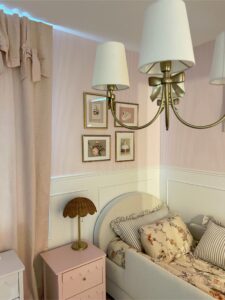
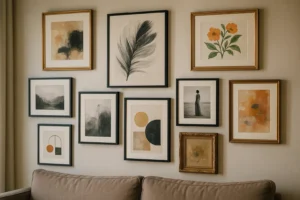
Wall treatments offer another opportunity for expression. Rather than overly decorative elements, consider refined wallpapers, framed illustrations, or even textured finishes that invite touch. Chalkboard or magnetic walls can be integrated discreetly, offering creative freedom without visual chaos.
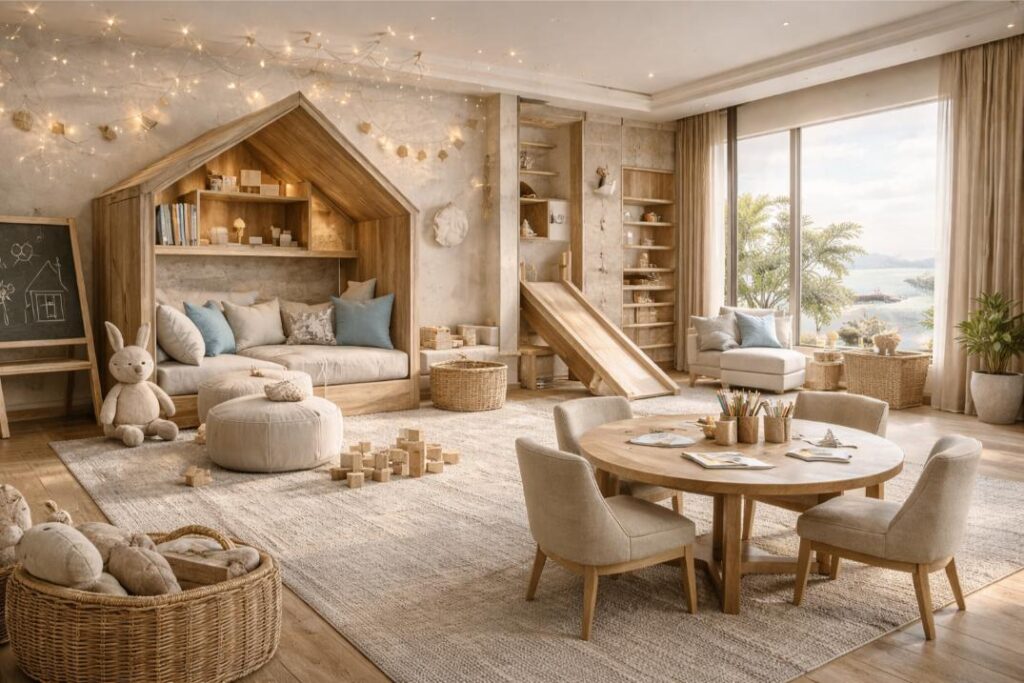
Lighting deserves special attention. A combination of ambient, task, and accent lighting allows the room to adapt throughout the day. Soft, diffused lighting creates a welcoming atmosphere, while sculptural fixtures can add a touch of character without appearing childish.
Personal elements complete the space. Displaying children’s drawings, travel memories, or meaningful objects adds warmth and authenticity. When thoughtfully curated, these details enhance the emotional value of the room while maintaining its refined identity.
A Playroom Designed as Part of a Larger Vision
In high-end interiors, no space exists in isolation. A children’s playroom should be designed as an integral part of the home, reflecting the same attention to detail and architectural coherence found elsewhere.
Studios such as Sabrina Monte-Carlo approach children’s spaces with this holistic mindset, ensuring that playrooms align seamlessly with the overall aesthetic of the residence. The result is a space that supports childhood wonder without disrupting the elegance of the home.
Luxury, in this context, is not defined by decoration alone, but by the intelligence of the design. It lies in custom solutions, discreet integration, and an understanding of how families truly live. A playroom designed with these principles becomes a space that evolves with the child, remaining relevant, functional, and beautiful over time.
Where Joy and Elegance Coexist
Creating a children’s playroom that is both fun and fantastically luxurious is not only possible : it is a natural extension of thoughtful interior design. By prioritizing safety, functionality, and emotional comfort, while carefully layering refined materials, subtle colors, and bespoke solutions, the playroom becomes a meaningful part of the home.
More than a place for play, it becomes a space for growth, imagination, and shared moments. When designed with intention, a playroom reflects the same values as the rest of the interior: balance, harmony, and understated sophistication.
As demonstrated in projects envisioned by Sabrina Monte-Carlo, children’s spaces can embrace joy without ever compromising elegance ; proving that luxury and playfulness can indeed coexist beautifully.




Post Comment